Thursday, February 21, 2013

BRAINSTORMING FOR SEARCH TERM & BOOLEAN OPERATORS- WEEK 5

 Assalamualaikum. Today I will talk about what I have learnt in week 5. Big topic for this week is brainstorming for search term. What I understand about this topic, they teach us how to search information easily using keyword or subject heading and so on. Firstly, when we should using keyword? When you're first starting to formulate your research question, it can be useful to brainstorm keywords that are synonymous with or related to the major concepts of your topic, as well as narrower and broader terms. Subject heading usually will give you specific information about the book that you search. There are many types of subject heading such as Library subject heading, Science subject heading, or Thesaurus Psychological Index term.

 In addition, we have learnt about BOOLEAN OPERATORS. From my understanding, word for Boolean was got from the name of mathematician there was George Boole. There are combining terms AND, OR, NOT. Boolean Searching : this allows us to group words together in an electronic database or environment such as WWW (world Wide Web). Each words will come out with different results. This is the most common and basic strategy.


      AND 
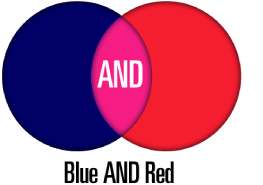
  By using an AND between words you limit the search.

OR
  By placing an OR between words it expands the search.
  When you use OR you receive more information because the search engine is looking for two words rather than just one word.

NOT

 'not' operator which allows you to exclude words from the search.
If a document has a word that you would like to search but that document also contains another word that you do not want to retrieve, then it will exclude that document from you search query results.

Thursday, February 14, 2013

SEARCH TOOL : ONLINE DATABASES - WEEK 4


Assalamualaikum.. Today I will write my reflection on week 4.. What I learnt in week 4 was about online databases and their example. What I knew about this is online databases is search engine tool that can occurs as simple screen or advance screen.  This is the example of simple screen.


ONLINE DATABASES - subject , keyword, full text
We can access online Database through our own library portal. We try to click DAtabase on trial and they will give us intruction to go far. 

Thursday, February 7, 2013

SEARCH TOOLS:LIBRARY CATALOGUE n INTERNET :) WEEK 3

Assalamualaikum. Now already in week 3. Topic for this week is about library catalogue. From this lesson I got to know how to use online library catalogue. I never use that kind of way to find information of book, but this lesson made me more interested to use OPAC. From my understanding about library catalogue, that is the system that allow user to find out information about book. From that, we get to know the characteristic a book. OPAC is contain a record of each book, audiovisual and so on. From that, we could know where is the place of that book and their format also. Through OPAC also we can renew our book in express way.

Library card catalogue is a file cabinet containing individual cards with bibliography information about specific item in library. Computerized online catalogue(OPAC) have all materials in library that we can find information more quickly and efficiently from internet. This is the example of OPAC that AIU use for their library:

We have to know about OPAC because :
> Allow us to do a better job of locating books and other materials available through our libraries as well as other libraries.
>This can be a big help and time-saver in your search for information that is needed for papers or projects.

There are 4 types of searching such as Browse, Keyword, Reserve and Expert.
Actually still have many type of searching in each online library. Through KEYWORD search, we just enter maybe their first capital, and the system will give us suggestion.

SEARCH TOOL: INTERNET


From this lesson, I know about internet search tool that actually we are using that almost everyday. I get to know the strength or weaknesses of each search tool. From here, I wanted to change my own search tool at my laptop. A web search engine is designed to search for information on the World Wide Web. Internet is the electronic network that connect our personal computer around the world. Many kind of things that we can find from internet.

There are 5 types of search tool of internet. One of them is a SEARCH ENGINES. It is designed to search for information in World Wide Web. For example that we often use is www.google.com.
Beside search engines, there is a META-SEARCH ENGINES. It is a multiple data sources. It is also search tool that sends user requests to several other search engines or databases and aggregates the results into a single list. Example of Meta-Search engines is  MetaCrawler(http://www.metacrawler.com)             
 Dogpile (http://www.dogpile.com)
Have another types of seacrh tool of internet  that I have learnt such as INFORMATION GATEWAY, SUBJECT DIRECTORIES, and at last is SPECIALIZED DATA. Thats all for this week :) thankss for reading ..

Thursday, January 31, 2013

PRIMARY,SECONDARY,TERTIER SOURCES :) WEEK 2


Assalamualaikum.. Today i want to share about what i have learnt in this week.. 
What I’ve learnt in week 2 is about sources. Okay, what do you know about sources? Source is actually something like the tools or search strategies to find information. You know what, before this I did not know well about the sources. For your information, there are three categories of sources:
1.      Primary sources
2.      Secondary sources
3.      Tertiary sources

PRIMARY SOURCES 


Contemporary Accounts - of an event written by the person who witnessed or experienced it.
      Original Document  – not about another document or account.
      Published works  - as long as they are written soon after the fact and not  as historical accounts

     What is a primary source?
 A primary source is an original object or document, first-hand information.
       Primary source is material written or produced in the time period that you may be investigating.
       Primary sources enable the researcher to get as close as possible to   what actually happened
      during an historical event or time period.   
Example:
DIARY
LETTER


SPEECHES

                                                                     MANUSCRIPT
SECONDARY SOURCES

What is a secondary source?
Is something written about a primary source.
      Are written "after the fact" - that is, at a later date.
      Usually the author of a secondary source will have studied the primary sources of an historical period or event and will then interpret the "evidence" found in these sources.
     As second- hand information.
     Interpret primary sources - at least one step removed from the event or  phenomenon under review
     Examination of studies that other researchers have made of a subject .

Example :


ENCYCLOPEDIA


HISTORY TEXTBOOK 


You know what?Newspaper and magazine articles can be a primary or secondary source. 
 If the article was written at the time something happened, then it is a primary source. 
However, if a reporter in 2009 wrote about George Washington’s inauguration using information written by someone else (1789), that would be asecondary source.


TERTIERY  SOURCES
 >Collection of primary and secondary sources
 >Includes most types of references.
 Example:
 guides to the literature